For padel clubs running weekend tournaments on a handful of courts

Every club has the same problem: not enough courts.

Padel is always doubles and clubs rarely have more than four courts, so the entry list is capped by arithmetic long before it is capped by interest. Tournamyx shows you exactly what fits before you open registration.

Free for small events · Nothing to install

If any of these sound familiar

  • Sixteen pairs signed up and four courts to play them on
  • A draw that overruns and a club night booked at seven
  • Pairs sitting for two hours between matches
  • Someone at the desk retyping scores from a paper sheet

We built Tournamyx for padel organizers in exactly this situation.

Field guide — padel organizers

Court count decides your entry list

Padel clubs typically have between two and six courts, and a tournament match at short sets runs about forty-five minutes with the changeover. That gives one court around nine matches in a long day, and it is the number every other decision follows from.

Sixteen pairs as a straight knockout is fifteen matches — on four courts that is eight rounds of court-time, about six hours, and half your entries play once. The same sixteen pairs in four groups of four feeding quarter-finals is thirty-one matches: twenty-four in the groups plus seven in the knockout, around six and three-quarter hours on four courts, with every pair guaranteed three matches. Forty-five minutes more for triple the padel.

That comparison is why groups win at almost every club tournament. Work out your own numbers before registration opens rather than after — the group stage + knockout generator takes your real pair list and shows the match count and round count immediately.

16 pairs, 45-minute slots, four courts

FormatMatchesGuaranteed matchesCourt time
Straight knockout151~6h
4 groups of 4 + quarters313~6h 45m
2 groups of 8 + semis597~11h

What Tournamyx does not do: Americano and Mexicano

Worth getting out of the way early, because it is the first thing a padel organizer asks. Americano — where partners rotate every round and points are scored individually — and Mexicano, where the pairings are drawn from the current individual standings, are not supported formats on Tournamyx and are not planned.

Those formats are a genuinely different model: the unit being ranked is a player rather than a pair, and the pairing rule changes between rounds. Everything Tournamyx does assumes a fixed entrant that persists through the event. Saying so plainly is more useful than a feature list that quietly omits it.

What does work is any tournament of fixed pairs: a round robin where every pair plays every pair, a knockout draw with seeds and byes placed, groups feeding a knockout, or a Swiss that pairs teams on equal records without eliminating anyone. For a club social where people want to play with everyone, Americano is the right format and you should run it on something built for it.
Keeping four courts moving without a runner

The operational problem at a padel tournament is small and constant: four courts, a match ending every ten minutes or so somewhere, and pairs who are somewhere in the clubhouse rather than watching the desk. Matches start late because someone had to be found, and fifteen minutes lost per round is an hour across the day.

A public link removes most of it. Every Tournamyx event publishes one URL with no login and no install, so a pair can see their own next match and court number, and how far the current round has to go, without asking anyone. The desk stops being a paging system.

Scores go in from any phone courtside, and roles are per tournament so a club coach or a player can enter results without being able to edit the draw. Group tables recompute on every result and the knockout fills automatically when the last group match is scored — which is the twenty minutes most club tournaments lose at the halfway point.

The comparison

Match day, two ways.

Every tournament hits the same five moments. The difference is whether you handle them from a spreadsheet or from one link.

The momentThe usual wayWith Tournamyx
The scheduleAn Excel sheet that lives on one laptopOne link, always current, on every phone
Score updates47 unread WhatsApp messages on match dayStandings update themselves as scores go in
A team drops outRedraw the bracket by hand, againDrag, drop — the bracket adjusts on its own
“What time is our match?”Answered forty times, individuallyAnswered by the link, once
After the finalTypos on the printed bracket sponsors sawA clean recap sponsors actually post

If the middle column reads like your last event, Tournamyx was built for you.

What it handles

Built for the moment something goes wrong.

Five places where most tournaments fall apart. None of them will be yours.

01/Scheduling

From team list to full schedule in ten seconds.

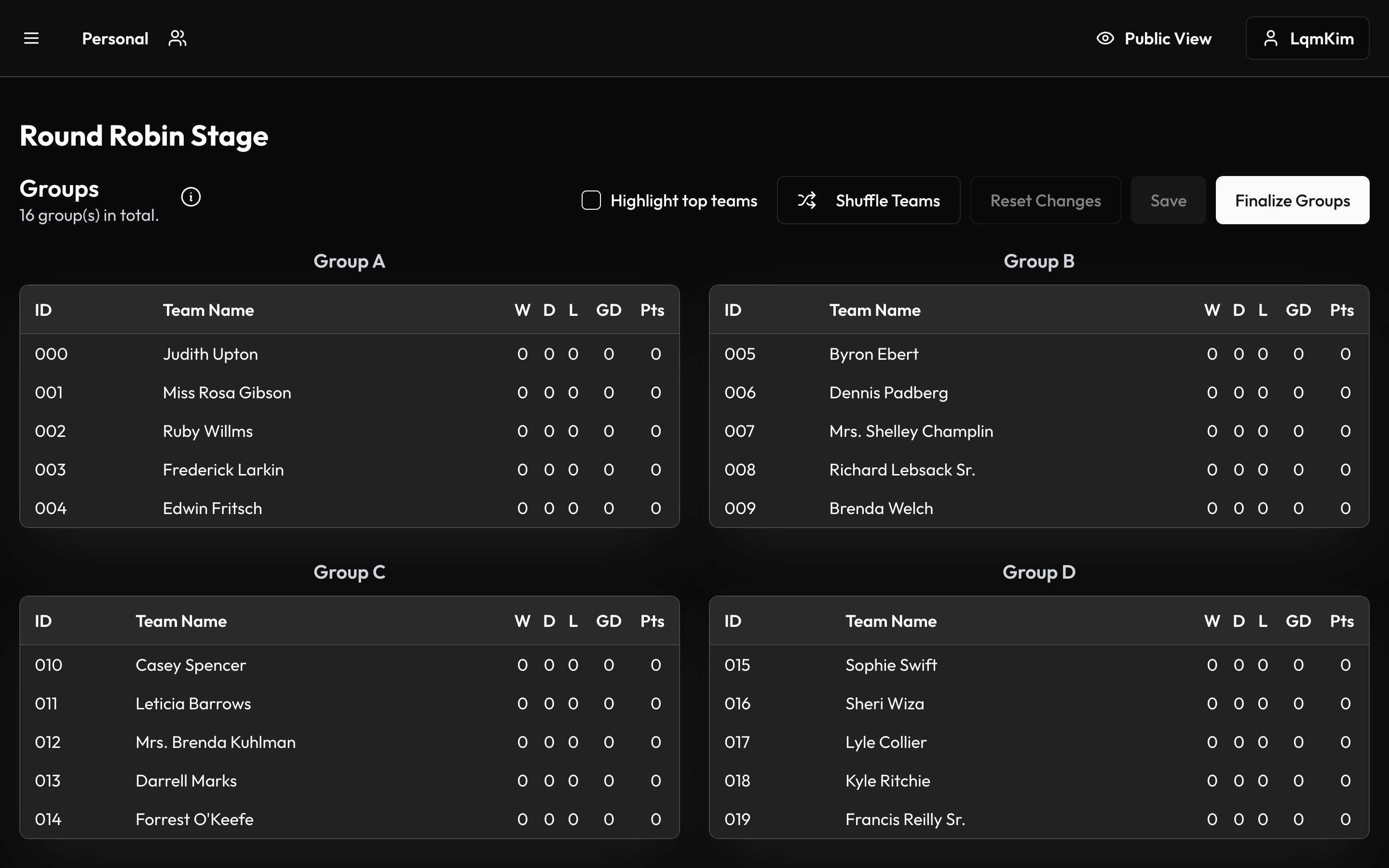
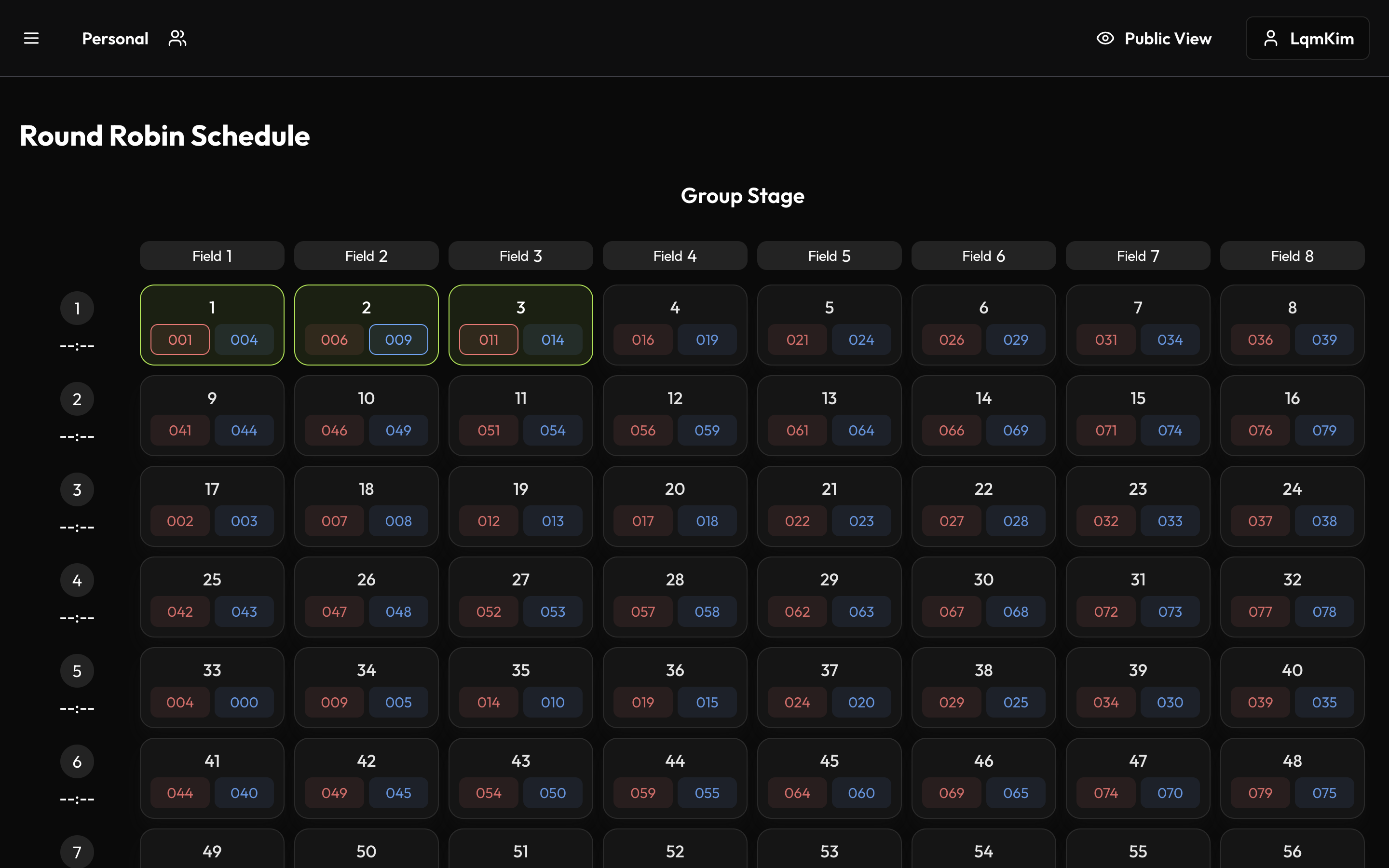
Enter your teams, groups, and courts. Tournamyx lays the whole schedule out across them, round by round — the job that used to eat your Saturday night.

Formats
Round-robin, knockout, Swiss, attempts
Scale
8 teams or 406 — same workflow
Courts
No field ever sits empty
Generated round-robin schedule with matches assigned across eight fields

02/Preview

Catch the mistake before anyone sees it.

Walk through every fixture, field assignment, and standing before you publish. Spot the imbalance or the awkward matchup while nobody’s watching.

Dry run
The whole event, before it goes public
Fixtures
Every match and field, laid out
Standings
Group tables and bracket progression
Tournament preview showing group stages and knockout bracket progression

03/Changes

A team drops out. Nobody notices.

Thirty minutes before kickoff, someone always cancels. Drag the team out, drop a replacement in — the bracket and the public link adjust on their own.

Edits
Drag-and-drop teams and fixtures
Seeding
One-click randomiser for contested draws
Rebuilds
Never
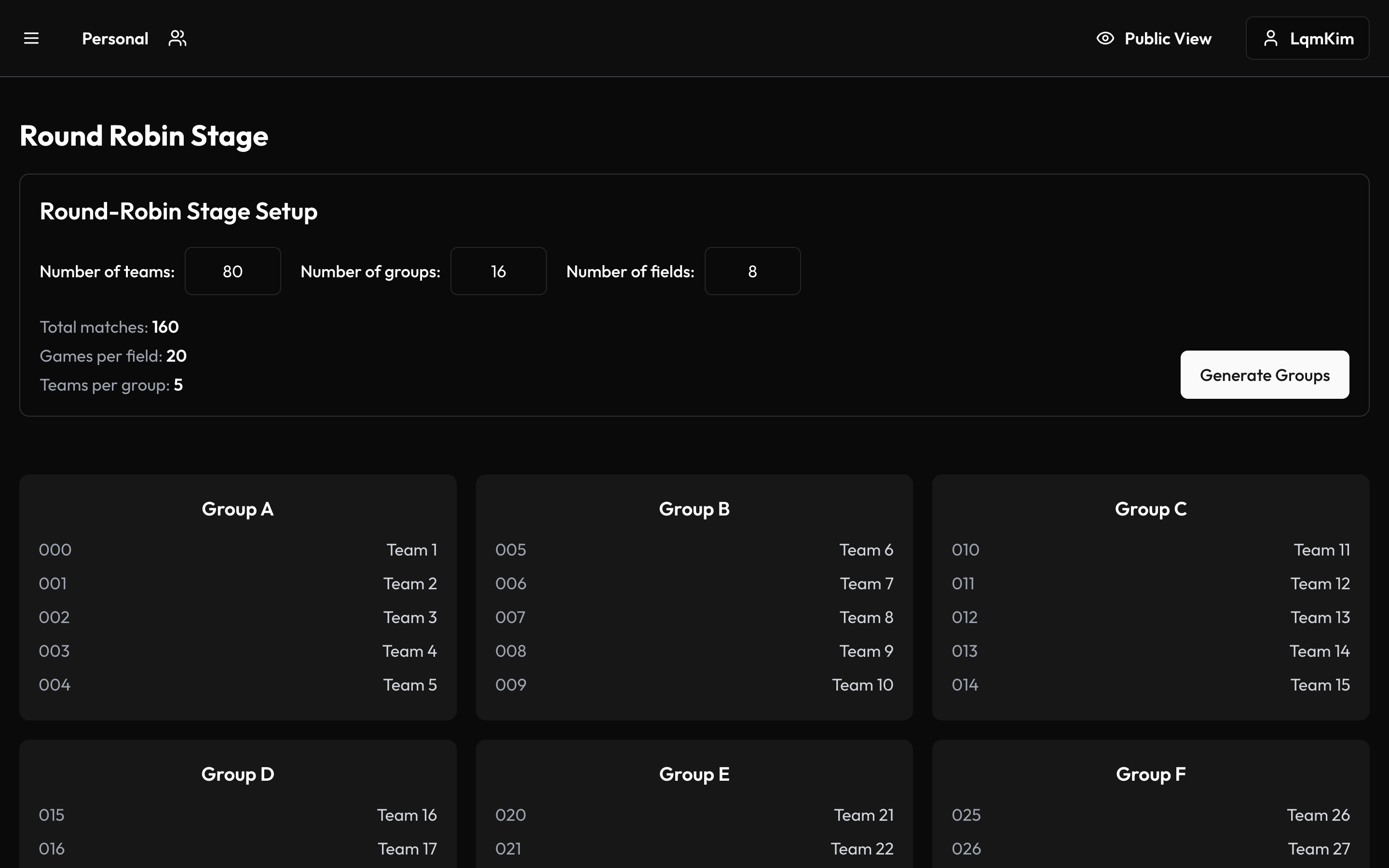
Tournament setup with drag-and-drop team and group management

04/Scoring

Type the score. Everything else updates.

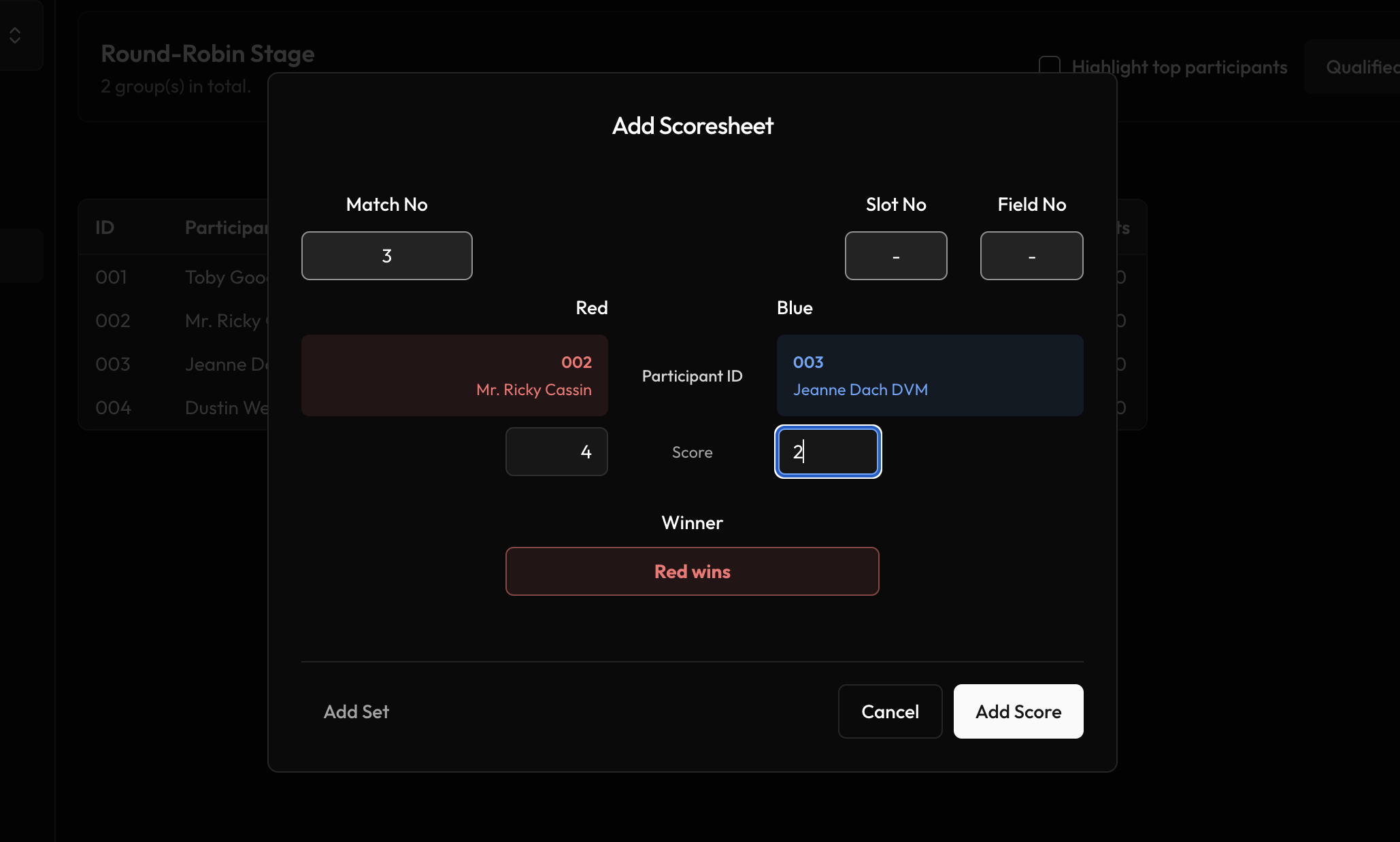
The scorer picks the match, types the result, hits save. Standings recalculate, the bracket advances, and the public link shows it — before the teams have left the court.

Entry
Match, field, and set scores in one dialog
Standings
Recalculated on every save
Devices
Any phone at the scorer’s table
Scoresheet dialog recording a 4–2 result with match, slot, and field numbers and the winner marked

05/Collaboration

Split the courts, not the spreadsheet.

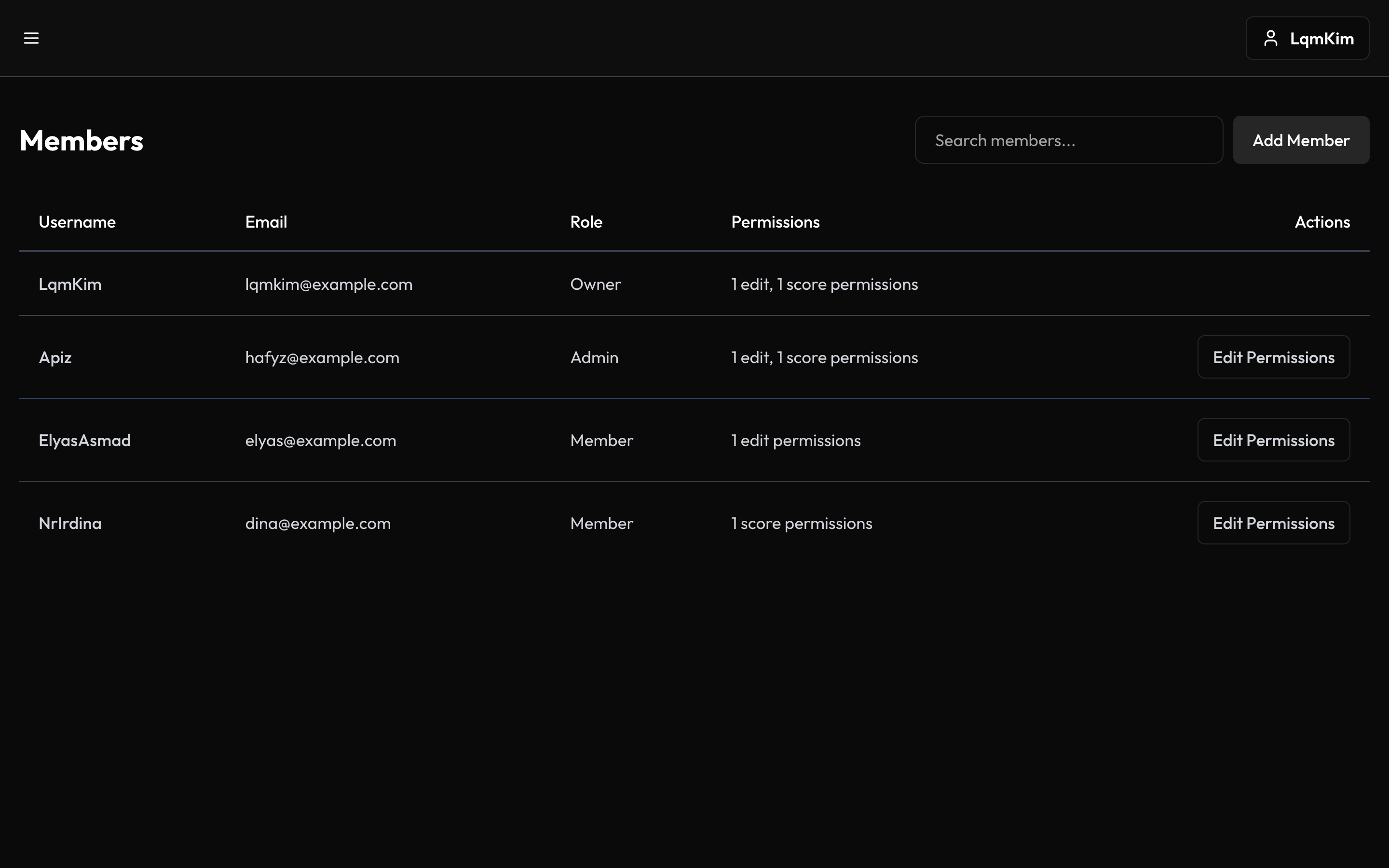
Invite co-scorekeepers with the right permissions and divide the venue between you. Every score lands in the same live standings — no “who has the latest sheet?”

Roles
Owner, admin, member — plus per-tournament scoring
Sync
One source of truth, on every device
Scorekeepers
Several at once, granted per tournament
Members management showing scorekeeper roles and permissions

Case study — IIUMRC, Jul 2025

The 406-team international championship that proved the point.

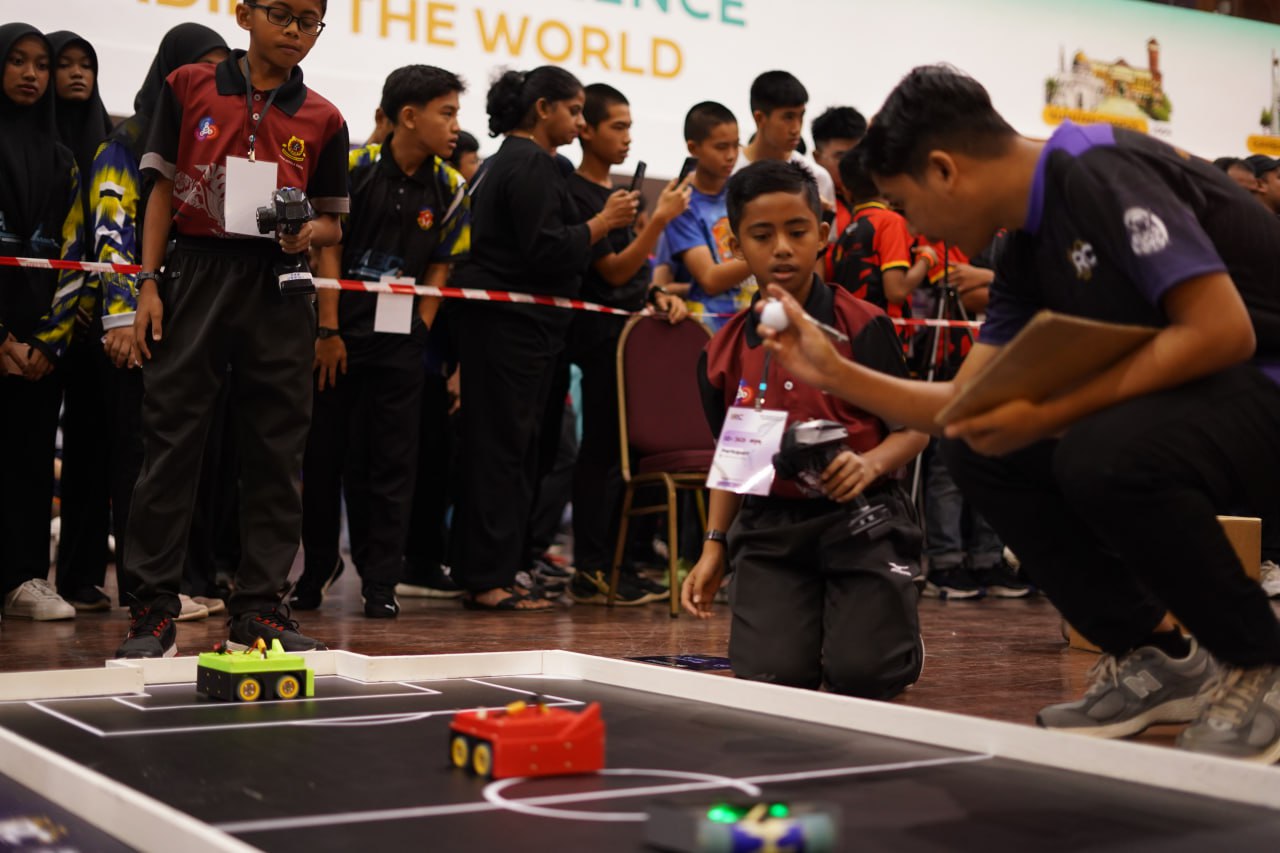
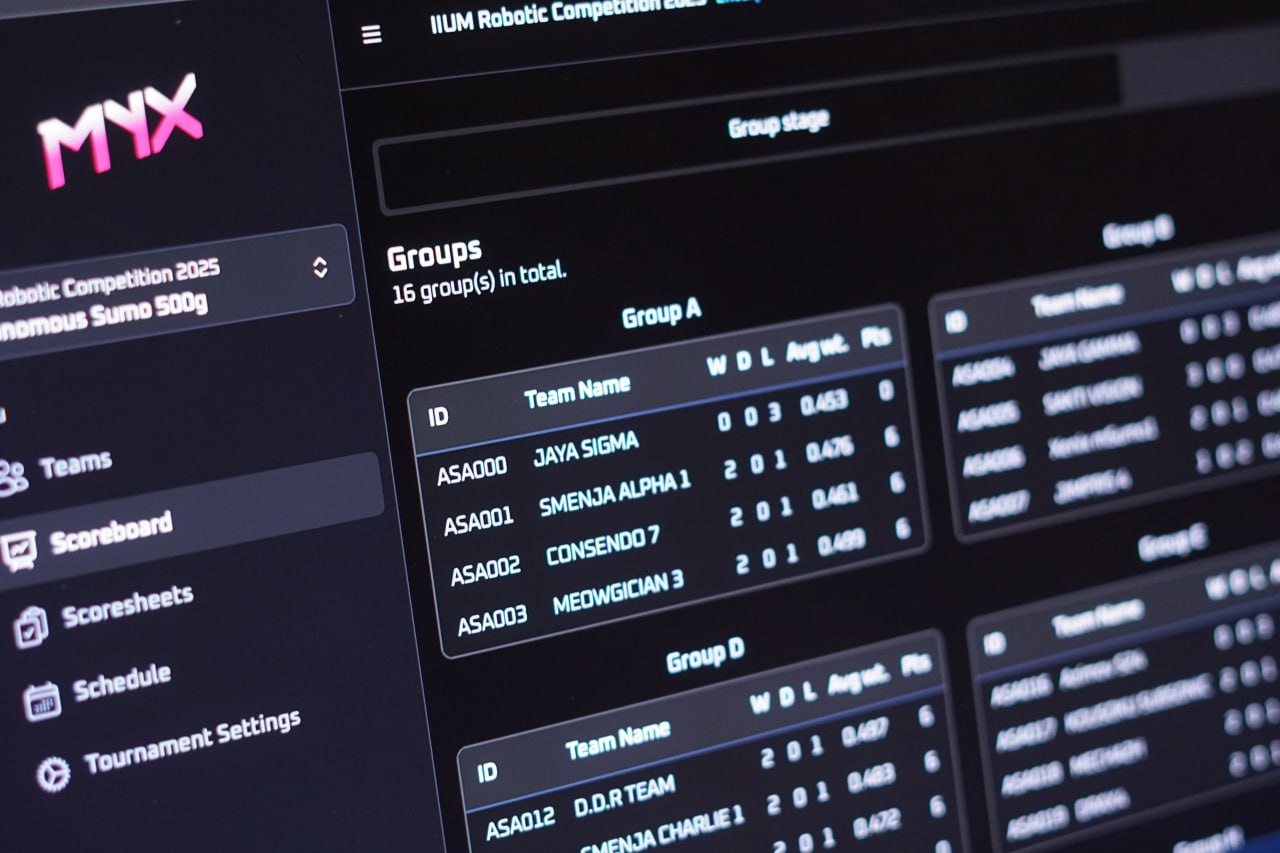
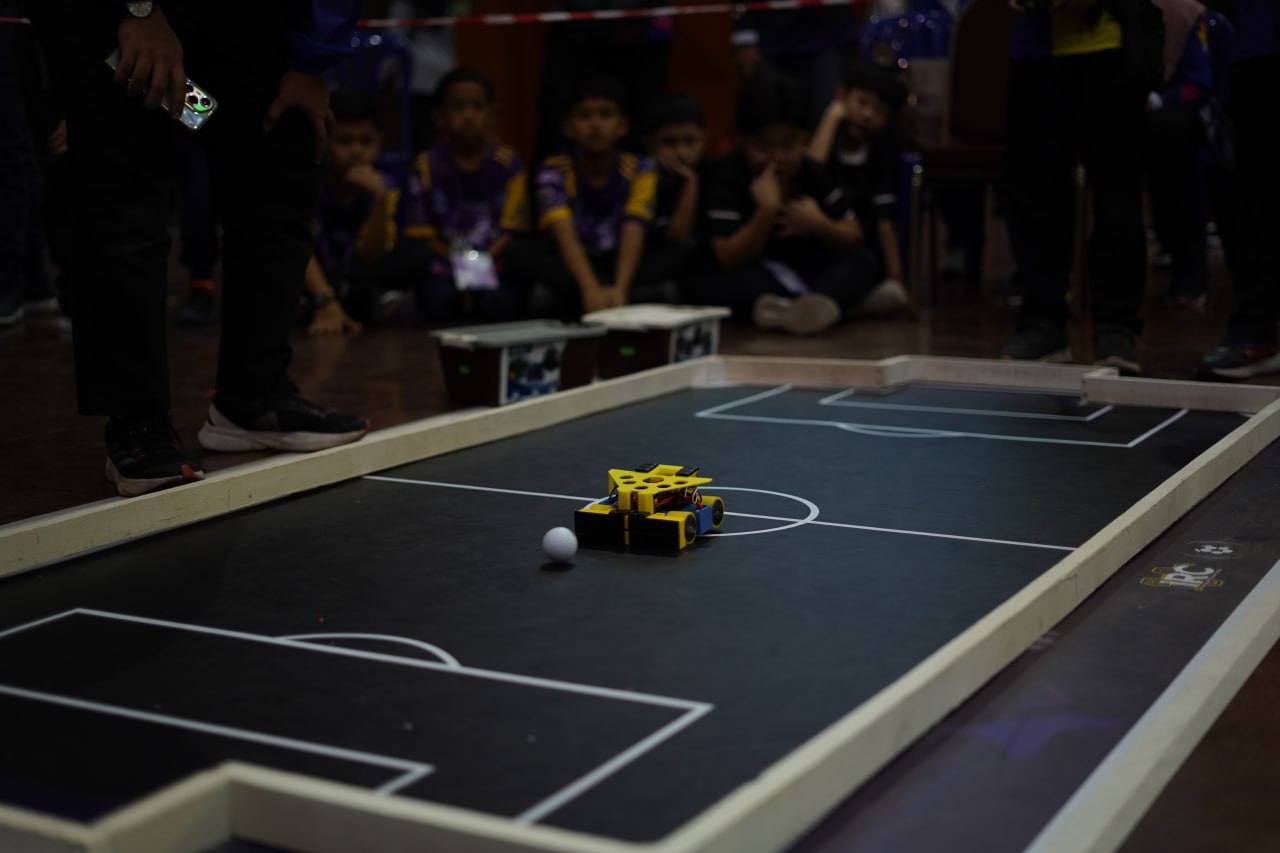
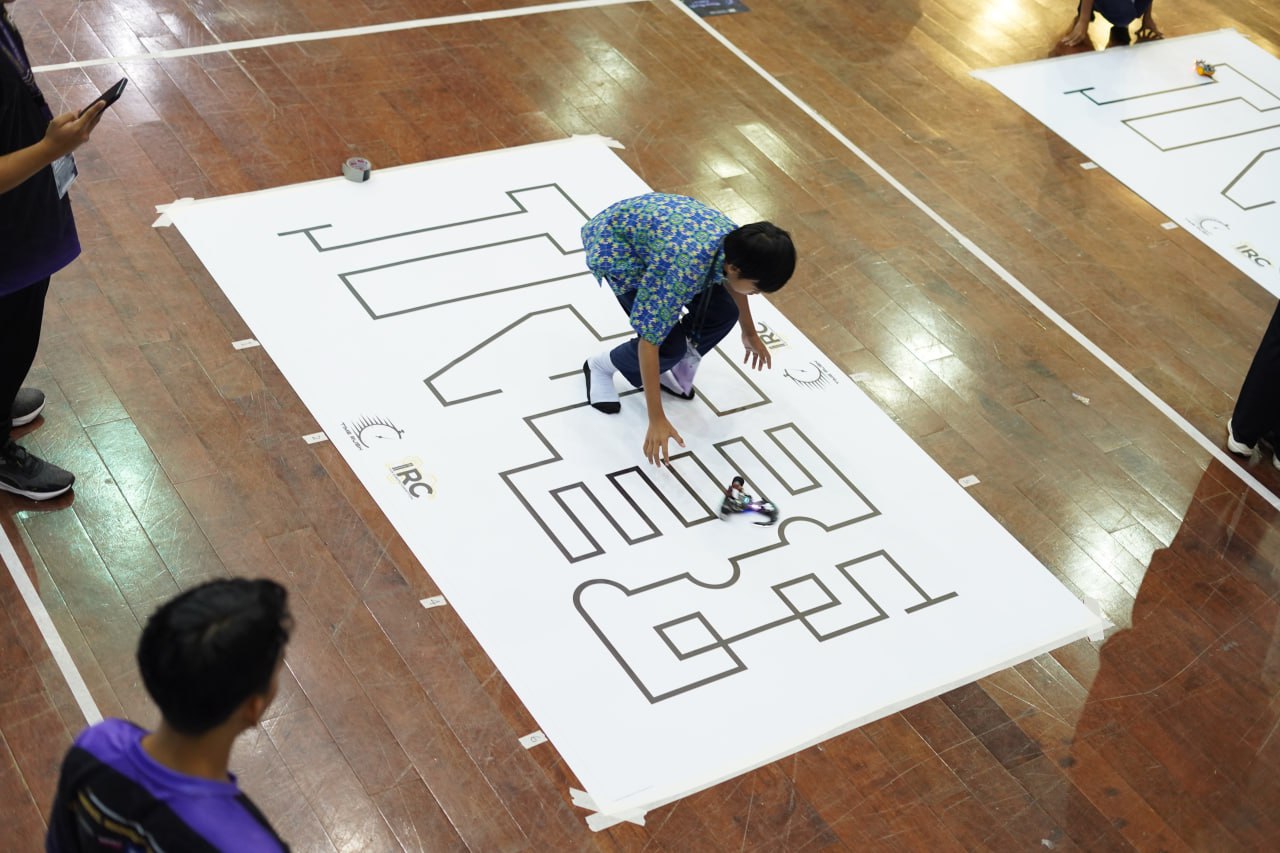
In July 2025, Tournamyx ran the IIUM Robotic Competition — the annual international robotics tournament at IIUM Gombak, where school teams from Malaysia and abroad battle in sumo, robot soccer, and time-rush events. 406 teams across three categories, 755 matches scheduled and scored live, every standing on one public link. If it can run an international robotics championship, it can run your Sunday futsal night.

Read how we did it →
406
teams
755
matches
3
categories
1
public link
Robotics teams competing on the arena floor at IIUMRC 2025
01/The arena floor
Packed hall during the IIUM Robotic Competition group stage
02/The hall at capacity
Scorekeepers tracking live matches on Tournamyx
03/Scores going in live
Teams checking the live schedule between matches
04/Checking the next match
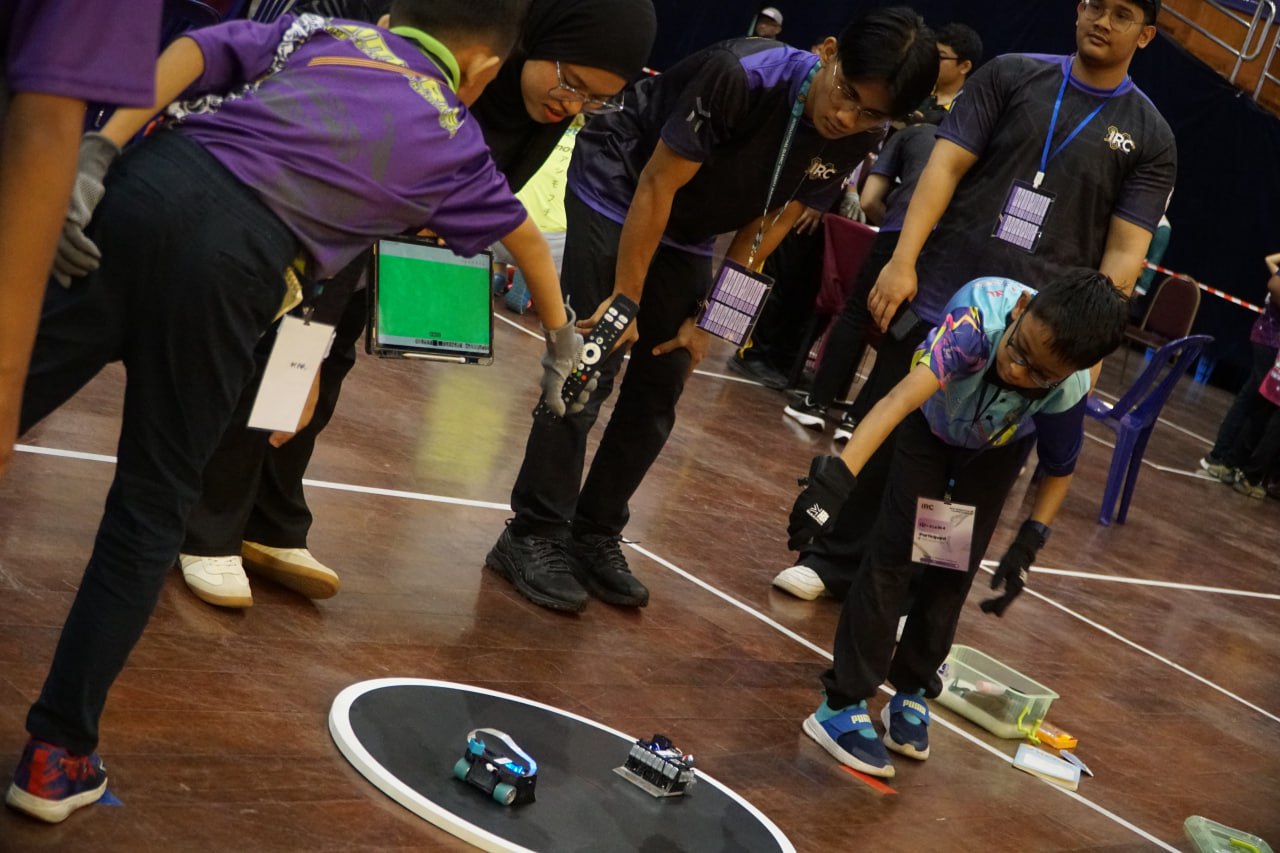
A match in progress at the IIUM Robotic Competition
05/Mid-match
Organizers coordinating fields during the knockout rounds
06/Eight fields in sync
Finalists at the IIUM Robotic Competition closing ceremony
07/The finalists

Questions

Asked before every first event.

Something else? Chat with us on Telegram

Weighing up other tools? Here’s a neutral checklist for comparing them.

Can I try Tournamyx without creating an account?

Yes. You can build a full tournament at scores.tournamyx.com without signing up — Tournamyx creates a guest session, and an account is only required when you publish the event, add an organization, or upgrade. The free generators on tournamyx.com need no account at all.

What happens when a team drops out mid-event?

Tournamyx lets you drag a team out of a running tournament and drop a replacement in. The bracket, the standings, and the public link everyone is checking all update together — no rebuild, no group-chat announcement, and nothing redrawn by hand.

Can more than one person enter scores at the same time?

Yes. Tournamyx supports owner, admin, and member roles plus per-tournament scoring permissions, so you can invite co-scorekeepers and have several people scoring at the same time from different courts. Every score lands in the same standings.

How does Tournamyx handle byes in a knockout bracket?

Tournamyx places byes automatically, so an organizer never has to work out the bracket padding by hand. Tournamyx seats them on the top seeds, advances those teams straight to round two, and redraws the bracket if the team count changes before kick-off.

Can I seed the draw, or randomise it?

Tournamyx supports both. You can seed teams deliberately so the strongest sides meet late, or use the one-click randomiser for a contested draw, and Tournamyx builds the bracket from whichever order you settle on.

How are group standings ranked and ties broken?

Tournamyx ranks group tables on match points and recalculates them on every save. Tie-breaks are applied automatically, and attempt-based events can rank on custom metrics such as fastest time or highest score instead of points.

Can I print the schedule and scoresheets?

Yes. Tournamyx exports the full match schedule and blank scoresheets for every field as print-ready PDFs, for referees, judges, and the registration desk. On the Pro plan those PDFs carry your organization logo.

Can I run more than one tournament at the same time?

Yes, on every plan including Free. Tournamyx does not limit how many tournaments you run or how many are active at once — the plan limit is on players per tournament, not on the number of tournaments.

Can I put sponsors on the public results page?

Yes, on Pro. Tournamyx shows unlimited sponsors on the public event page and reports click-throughs and audience analytics afterwards, so you have something concrete to send a sponsor after the final.

Which sports is Tournamyx used for?

Tournamyx is used for futsal, football, volleyball, basketball, badminton, pickleball, chess, esports, robotics and STEM competitions, university sport, school sports days, and corporate events. The formats differ from sport to sport; the scheduling and live-scoring engine underneath is the same.