16 team bracket generator fifteen matches, no byes
Sixteen is the biggest bracket that still fits a single day comfortably, and like eight it fills a draw exactly: no byes, four clean rounds, round of 16 through to a final. Paste sixteen names and it resolves as you type.
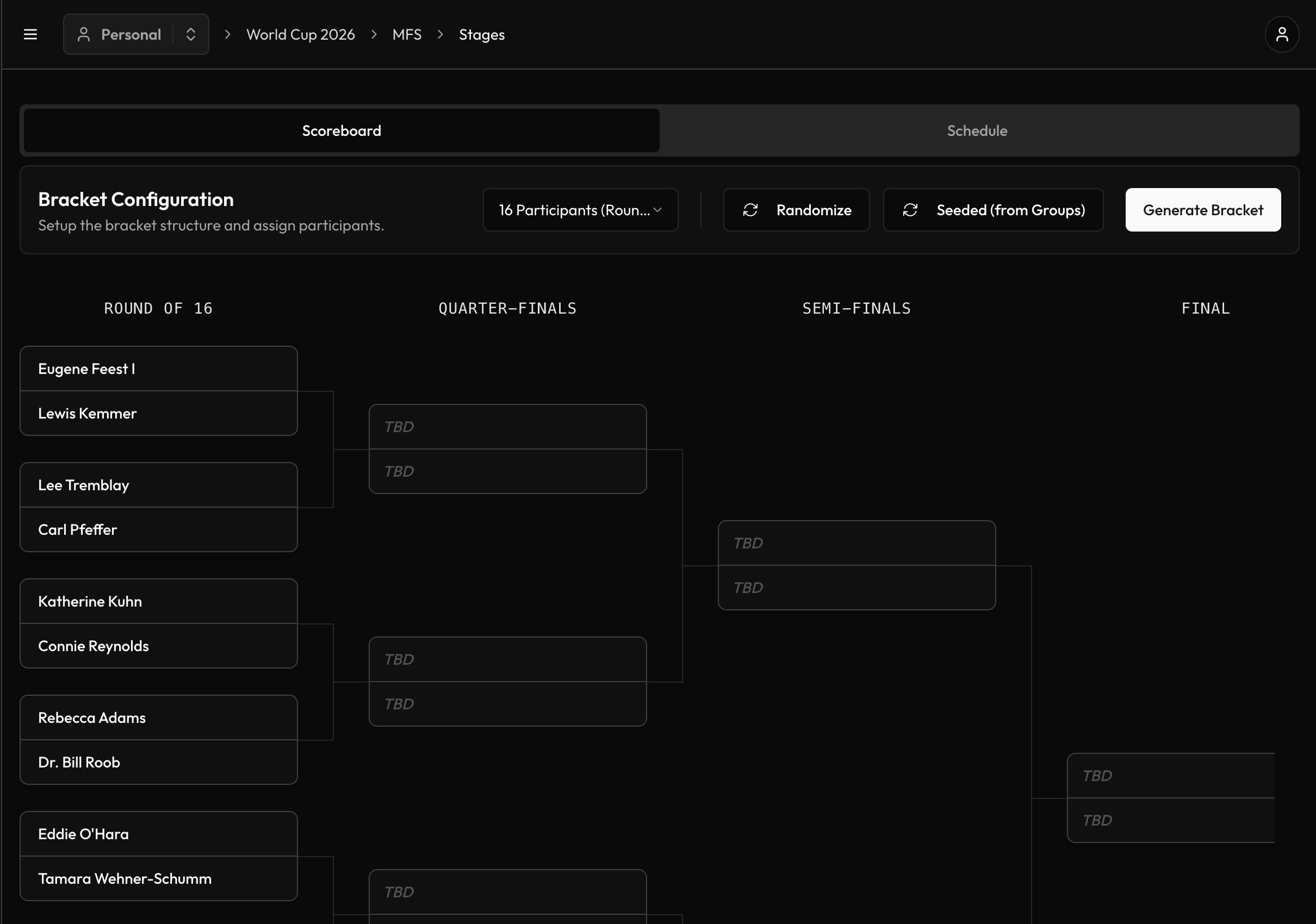
16 teams · 15 matches · 4 rounds · type scores to advance winners
Round of 16
Quarter-Finals
Semi-Finals
Final
Type scores straight into the bracket and winners advance automatically. Nothing is saved here; save it on Tournamyx Scores to score live and share the link.
Free up to 8 players · $12 unlocks one event up to 64 · No subscription
In brief
What does the 16 team bracket generator do?
The Tournamyx 16 team bracket generator draws a knockout for sixteen teams with no byes at all, because sixteen fills the bracket exactly. Every team enters in the first round and the ladder runs to the final.
A 16-team single-elimination bracket runs 15 matches across 4 rounds, with no byes, because 16 is already a power of two.
Every generator on Tournamyx is free and needs no account. Running the same event live, with scores, standings and a public link, happens at scores.tournamyx.com, free for up to 8 players.
16 team bracket at a glance
- Makes
- A sixteen-team knockout: round of 16, quarter-finals, semi-finals and a final
- Best for
- The largest field that still runs comfortably as a straight knockout in one day
- Price
- Free, with no usage limit, because the generator on this page is not metered
- Account needed
- Nothing to sign up for and nothing to install
- Data stored
- Nothing. The generator runs in your browser, and closing the tab discards the draw
- Largest field
- 16 teams as this page is set up, and up to 64 if you paste a longer list
- Where it stops
- Half the field is out after the opening round. Guaranteeing more than one game at this size means a group stage or a double elimination draw
- Live version
- Tournamyx Scores runs the same event live, free for up to 8 players, with a public link spectators open without an account
How it works
Build a 16 team bracket in three steps.
- 1~2 min
Enter your sixteen teams
Paste the list in seed order, or shuffle for an open draw. At sixteen teams the seeding decides the shape of the whole day, so it is worth getting right.
- 2~5 sec
Read the round of 16
Sixteen fills the bracket exactly, so nobody gets a bye. Seed 1 meets seed 16, and the top four seeds land in separate quadrants so they cannot meet before the semi-finals.
- 3done
Score it live
Enter results and winners advance through four rounds to a final. On Tournamyx Scores the same bracket updates on every phone watching it.
Field guide
Fifteen matches over four rounds — and how long that really takes
Sixteen teams means fifteen matches, because fifteen teams have to lose for one to win. They fall into four rounds: eight in the round of 16, four quarter-finals, two semi-finals, one final. No byes, no uneven paths, every finalist has won exactly three matches.
The run time depends almost entirely on court count, because the first round is eight matches wide and cannot be compressed below that width. On two courts with 25-minute slots it is eight slots, or about three hours and twenty minutes. On four courts it drops to five slots, roughly two hours. On eight courts the round of 16 fits in one slot, but you still need four slots total, because the final cannot start until the semis finish.
That sequential-round ceiling is the single most common scheduling mistake at this size: organizers book six courts, assume six times the throughput, and discover the last two hours run on one court while everyone else watches. The tournament schedule maker shows where the width actually falls off.
16 teams, run time by court count (25-minute slots)
| Courts | Slots needed | Total time | Widest round |
|---|---|---|---|
| 1 | 15 | 6h 15m | Round of 16 |
| 2 | 8 | 3h 20m | Round of 16 |
| 4 | 5 | 2h 5m | Round of 16 |
| 8 | 4 | 1h 40m | Round of 16 |
Seeding by quadrant, not by pair
At eight teams seeding is a single decision: who plays whom in round one. At sixteen it is structural. Standard seeding puts seed 1 at the top of the draw and seed 2 at the bottom, then seeds 3 and 4 at the heads of the two middle quadrants, so the four strongest teams are spread one per quadrant and the semi-finals are 1 v 4 and 2 v 3 if form holds.
Get this wrong, by seeding only the first-round pairs and leaving the rest to chance, and you can put seeds 1 and 2 in the same half, which means your best match of the day is a semi-final and the final is an anticlimax. Everyone feels it, and nobody can quite say why.
The generator applies standard quadrant seeding from the order you type. If you want the underlying rules, including how to handle same-club protection and late withdrawals, how to seed a tournament bracket covers them.
Sixteen teams, one guaranteed game — is that acceptable?
A straight knockout at this size eliminates eight teams in the first two hours. For an invitational where every entrant expects a knockout, that is fine and understood. For an open-entry event where teams paid to enter, it is a problem you will hear about.
Four groups of four feeding quarter-finals costs 31 matches against the knockout’s 15, but guarantees every team three games, and on four courts it still fits in a long day. That is the World Cup shape, and at sixteen teams it is close to ideal, because sixteen divides into four groups of four with no awkward remainder. Build it with the group stage + knockout generator.
A full round robin at sixteen teams is 120 matches over 15 rounds, which is a season rather than an event. If you want more games than a knockout without that cost, a four-round Swiss is 32 matches, guarantees four games, and eliminates nobody early. The best tournament format for 16 teams compares all four with timings.


How many matches are in a 16 team bracket?
Fifteen, across four rounds: eight in the round of 16, four quarter-finals, two semi-finals and one final. Fifteen teams must be eliminated to leave one champion, and each match eliminates exactly one.
Does a 16 team bracket have byes?
No. Sixteen is a power of two, so every slot is filled and every team plays in the first round. Byes appear only when the team count is not 2, 4, 8, 16 or 32.
How long does a 16 team tournament take?
On 25-minute slots: about 3 hours 20 minutes on two courts, 2 hours 5 minutes on four, and 1 hour 40 minutes on eight. Rounds run in sequence, so four slots is the floor no matter how many courts you have.
How should I seed a 16 team draw?
By quadrant. Seed 1 at the top, seed 2 at the bottom, seeds 3 and 4 heading the two middle quadrants. That keeps the top four apart until the semi-finals and puts your best possible match in the final.
Is a group stage better for 16 teams?
It depends on your booking. Four groups of four into quarter-finals is 31 matches and guarantees three games each, versus 15 matches and one guaranteed game for a straight knockout. Sixteen divides perfectly into four groups, so there is no awkward remainder.
Can I print the 16 team bracket?
Copy the generated draw from this page as text, or run the event on Tournamyx Scores and export print-ready schedules and blank scoresheets for every court.
Kickoff
Your bracket,
five minutes from now.
Free up to 8 players · $12 unlocks one event up to 64 · No subscription