8 team bracket generator seven matches, three rounds
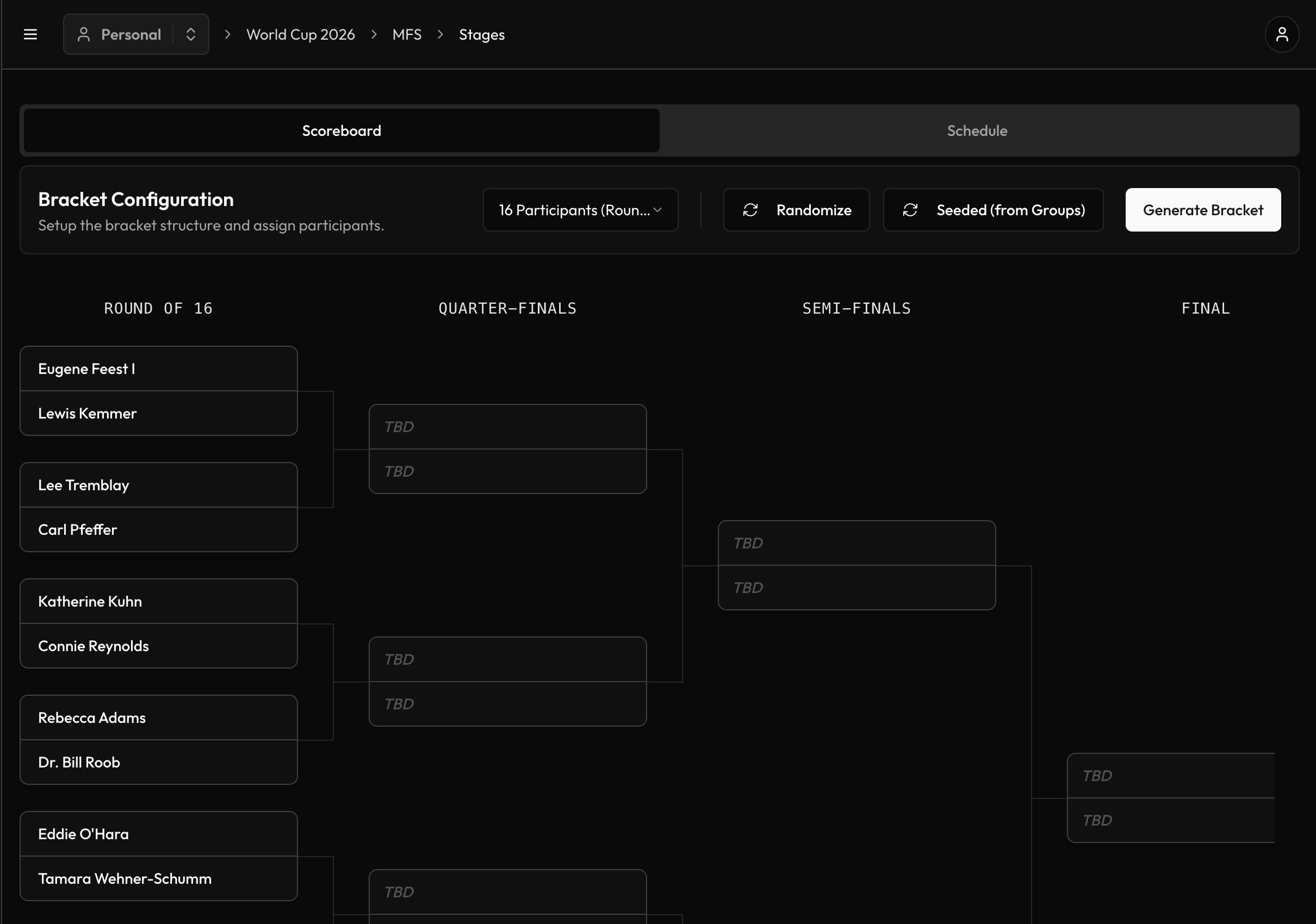
Eight is the number every knockout bracket wants to be: a clean power of two, no byes, quarter-finals straight through to a final. Fill in the eight names below and the whole draw resolves as you type.
8 teams · 7 matches · 3 rounds · type scores to advance winners
Quarter-Finals
Semi-Finals
Final
Type scores straight into the bracket and winners advance automatically. Nothing is saved here; save it on Tournamyx Scores to score live and share the link.
Free for up to 8 players · $12 per event beyond that · Nothing to install
In brief
What does the 8 team bracket generator do?
The Tournamyx 8 team bracket generator draws a knockout for eight teams, from quarter-finals through semi-finals to a final, with no byes, because eight fills the bracket exactly. Every team enters in the first round.
An 8-team single-elimination bracket runs 7 matches across 3 rounds, with no byes, because 8 is already a power of two.
Every generator on Tournamyx is free and needs no account. Running the same event live, with scores, standings and a public link, happens at scores.tournamyx.com, free for up to 8 players.
8 team bracket at a glance
- Makes
- An eight-team knockout: quarter-finals, semi-finals and a final
- Best for
- The most common one-day field size, and the cleanest bracket there is to run
- Price
- Free, with no usage limit, because the generator on this page is not metered
- Account needed
- Nothing to sign up for and nothing to install
- Data stored
- Nothing. The generator runs in your browser, and closing the tab discards the draw
- Largest field
- 8 teams as this page is set up, and up to 64 if you paste a longer list
- Where it stops
- Every team is guaranteed exactly one match. A field of eight that needs more games than that is better served by a round robin or two groups of four
- Live version
- Tournamyx Scores runs the same event live, free for up to 8 players, with a public link spectators open without an account
How it works
Build an 8 team bracket in three steps.
- 1~1 min
Enter your eight teams
Type or paste the eight names. Order them by seed if you have rankings, or hit shuffle for an open draw. The bracket redraws instantly either way.
- 2~5 sec
Read the quarter-final draw
Eight teams fill a bracket exactly, so there are no byes to place. Seed 1 meets seed 8, seed 2 meets seed 7, and the top two can only collide in the final.
- 3done
Score it live
Type a score and the winner advances up the bracket. Run the same draw on Tournamyx Scores and it advances on every spectator’s phone at once.
Field guide
Why 8 teams is the cleanest bracket size
Eight is a power of two, which is the only thing a single elimination bracket really cares about. Every round halves the field exactly, with four quarter-finals, two semi-finals and one final, so there are no byes, no team gets a free pass, and every survivor has won the same number of matches as every other survivor. That last point matters more than it sounds: in an uneven draw, a finalist who received a bye has played one fewer match than their opponent, and someone always notices.
The totals are fixed no matter how you seed it. Eight teams means seven matches and three rounds, because a single elimination tournament always plays exactly one match per eliminated team, and seven teams have to be eliminated to leave one champion. That formula, matches = teams − 1, holds for every bracket size, which is why the tournament bracket generator can tell you the match count before you have entered a single result.
On two courts with 25-minute slots the whole thing runs in about an hour and forty minutes: two slots for the quarter-finals, one for the semis, one for the final. On a single court it is seven slots, just under three hours. That is a morning, not a weekend, and it is the reason eight-team knockouts are the default shape for one-day cups.
8 teams under each format
| Format | Matches | Rounds | Guaranteed games |
|---|---|---|---|
| Single elimination | 7 | 3 | 1 |
| Groups of 4 + semis | 15 | 5 | 3 |
| Swiss (3 rounds) | 12 | 3 | 3 |
| Round robin | 28 | 7 | 7 |
The catch: half your field plays once
Seven matches is efficient, but it buys that efficiency by sending four of your eight teams home after a single game. If those teams travelled an hour to get there, a knockout is a bad deal for half your entry list, and they remember it when you open registration next year.
The standard fixes both cost time. Two groups of four feeding straight into semi-finals costs 15 matches instead of 7 and guarantees everyone three games, in about three hours on two courts. A full round robin guarantees seven games each but costs 28 matches, which is a full day. A three-round Swiss splits the difference at 12 matches with three guaranteed games and no team eliminated early.
Pick the knockout when the venue booking is the binding constraint and everyone knows they are entering a knockout. Pick groups when people have travelled. If you are still weighing it up, the best tournament format for 8 teams works through the same trade with real timings.
Seeding an 8 team draw so the final is worth watching
Standard seeding pairs strongest with weakest and keeps the top seeds apart as long as possible: 1 v 8, 4 v 5 in the top half, 2 v 7 and 3 v 6 in the bottom. Done properly, seeds 1 and 2 cannot meet before the final, and the two best teams in your event play the last match of the day rather than the second one.
If you have no rankings, shuffle instead of guessing. A random draw is honest, and an invented seeding that everyone can see is invented causes more arguments than no seeding at all. The generator above does both, and how to seed a tournament bracket covers the edge cases, including what to do when two teams from the same club enter.


How many matches are in an 8 team bracket?
Seven, played over three rounds: four quarter-finals, two semi-finals and one final. A single elimination bracket always plays one match per eliminated team, so eight teams means seven matches regardless of seeding.
Does an 8 team bracket have byes?
No. Eight is a power of two, so the bracket fills exactly and every team plays in round one. Byes only appear when your team count is not 2, 4, 8, 16 or 32.
How long does an 8 team tournament take?
About one hour and forty minutes on two courts with 25-minute slots: two slots of quarter-finals, one of semi-finals, one final. On a single court it is seven slots, just under three hours.
Can I add a third place playoff?
Yes. A third place match between the two beaten semi-finalists adds one match, taking the total to eight, and it runs alongside the final rather than after it if you have a second court free.
What if only 7 teams turn up?
The bracket regenerates with one bye, which goes to the top seed. Delete the missing team from the list above and the draw, round count and bye placement all update immediately.
Is the 8 team bracket generator free?
Yes, and eight teams is exactly the size Tournamyx Scores is free for, so run as many eight-team events as you like at no cost, with live scoring and a public link included.
Kickoff
Your bracket,
five minutes from now.
Free for up to 8 players · $12 per event beyond that · Nothing to install