Free tool · Swiss tournament generator
Swiss tournament generator that pairs every round for you
Swiss is the only format that gives a big field a full day of competitive matches without eliminating anyone — and the only one where the next round’s draw genuinely cannot be written in advance. Score a round below and watch the next one pair itself.
Free for up to 8 players · $9 per event beyond that · Nothing to install
8 teams · 3 rounds · 12 matches · nobody eliminated · round 1 of 3
Standings
3-1-0 · ties on Buchholz
| # | Team | P | W | D | L | Bye | Buc | Pts |
|---|---|---|---|---|---|---|---|---|
| 1 | Falcons | 0 | 0 | 0 | 0 | 0 | 0 | 0 |
| 1 | Sharks | 0 | 0 | 0 | 0 | 0 | 0 | 0 |
| 1 | Titans | 0 | 0 | 0 | 0 | 0 | 0 | 0 |
| 1 | Comets | 0 | 0 | 0 | 0 | 0 | 0 | 0 |
| 1 | Rhinos | 0 | 0 | 0 | 0 | 0 | 0 | 0 |
| 1 | Vipers | 0 | 0 | 0 | 0 | 0 | 0 | 0 |
| 1 | Eagles | 0 | 0 | 0 | 0 | 0 | 0 | 0 |
| 1 | Wolves | 0 | 0 | 0 | 0 | 0 | 0 | 0 |
Round 1
Round 2
Pairings appear once every round 1 match has a score. Swiss pairs teams on equal records, so the draw genuinely doesn’t exist yet.
Score a round and the next one pairs itself — winners meet winners, no pair ever meets twice. Nothing is saved here; Tournamyx Scores generates each round live and shares one link.
In brief
What is a Swiss tournament generator?
A Swiss tournament generator works out who plays whom in each round of a Swiss event, once the previous round has been scored. The Tournamyx Swiss generator pairs a field of up to 24 and recalculates the standings as results come in, so no round has to be paired by hand.
Every generator on Tournamyx is free and needs no account. Running the same event live — scores, standings and a public link — happens at scores.tournamyx.com, free for up to 8 players.
Swiss generator at a glance
- Makes
- The pairings for each round as it becomes available, plus standings that update as scores are entered
- Best for
- A large field that needs a full day of competitive games without anybody being knocked out
- Price
- Free, with no usage limit — the generator on this page is not metered
- Account needed
- None — nothing to sign up for and nothing to install
- Data stored
- Nothing. The generator runs in your browser, and closing the tab discards the draw
- Largest field
- Up to 24 teams or players in the generator on this page
- Where it stops
- A round can only be paired once the round before it is fully scored, which is a property of Swiss rather than a limit of the tool. How Swiss pairings, round counts and Buchholz tie-breaks work is covered in the Swiss system guide, not here
- Live version
- Tournamyx Scores runs the same event live, free for up to 8 players, with a public link spectators open without an account
How it works
Generate Swiss pairings in three steps.
- 01~2 min
Add your players or teams
Paste the list in seed order if you have ratings — round one splits the field in half and plays the top half against the bottom. No rankings? Shuffle for an open draw.
- 02~5 sec
Round one pairs instantly
The generator sets the round count at ⌈log₂ n⌉ — three rounds for eight players, five for twenty-four — and places a bye if your field is odd.
- 03each round
Score it, and the next round appears
Winners are paired with winners, losers with losers, and no two teams ever meet twice. Standings and Buchholz recalculate as you type.
Field guide
How this Swiss pairing generator builds each round
Round one is the only round that can be drawn in advance. The generator sorts your list by seed, splits it down the middle, and plays the top half against the bottom half — seed 1 against seed 9 in a field of 16. That is the standard slide, and it is why the order you paste your teams in matters.
Every round after that is paired from the results, not from the seedings. The generator ranks the field by points, then solves the whole round at once as a minimum-weight matching: rematches carry a penalty large enough that one is only ever chosen when no rematch-free pairing exists at all, then teams on equal points are kept together, then closer seeds are preferred. Pairing the leader greedily with their nearest valid opponent is easier to do by hand and reliably produces a worse round further down the table — which is the actual reason Swiss is painful on paper.
That is also why the widget above will not show you round two until every round-one match has a score. It is not a paywall or a loading state: in Swiss the next draw does not exist until the current results do. If you want the pairing rules themselves rather than a tool that applies them, how the Swiss system works covers them in detail.
Rounds and matches by field size
| Players | Rounds | Swiss matches | Guaranteed games | Round robin would be |
|---|---|---|---|---|
| 8 | 3 | 12 | 3 | 28 |
| 12 | 4 | 24 | 4 | 66 |
| 16 | 4 | 32 | 4 | 120 |
| 24 | 5 | 60 | 5 | 276 |
| 32 | 5 | 80 | 5 | 496 |
| 64 | 6 | 192 | 6 | 2,016 |
What Swiss actually costs you in court hours
Swiss match counts grow linearly, which is the whole point: rounds are ⌈log₂ n⌉ and each round is ⌊n ÷ 2⌋ matches, so doubling the field roughly doubles the matches instead of quadrupling them. Sixty-four players is 192 matches over six rounds; a round robin at the same size is 2,016.
The scheduling shape is different from a bracket, too. Every match in a Swiss round starts together and the round is only over when the slowest one finishes, so your day is round count × round length, not a widening-then-narrowing bracket. Sixteen players is eight matches a round: on four courts at 25-minute slots that is two slots per round and eight slots overall, about three hours twenty. The same sixteen as a straight knockout is five slots, roughly two hours — so four guaranteed games instead of one costs you about an hour and a quarter.
Where that trade stops working is when your entrants play at wildly different speeds and you have no clock. A slow board holds up an entire round, which is why chess Swiss events run a fixed time control and why chess organizers can promise a finish time that a knockout organizer cannot.
16 teams, four ways to run it
| Format | Matches | Guaranteed games | Eliminated early |
|---|---|---|---|
| Swiss (4 rounds) | 32 | 4 | Nobody |
| Single elimination | 15 | 1 | 8 after round one |
| 4 groups of 4 + quarters | 31 | 3 | 8 after the groups |
| Round robin | 120 | 15 | Nobody |
Standings, Buchholz, and finishing without a final
The generator scores 3-1-0 and treats a bye as a win, exactly as Tournamyx Scores does. Ties are broken on Buchholz — the sum of your opponents’ points — because in a format where everyone plays the same number of games, the only thing separating two teams on equal points is who they had to beat to get there. A bye counts as a virtual opponent scoring what you scored, so sitting out a round no longer quietly wrecks your tiebreak. Below Buchholz the order is head-to-head, then wins, then seed.
Publish that order before round one. Swiss finishes with teams level on points far more often than not — that is a property of the format, not a failure of it — and a tiebreak rule announced after the standings appear is the one thing that will get argued about at prize-giving.
The other property to plan around is that Swiss has no showpiece final. The last round is several simultaneous matches and the winner is whoever tops the table, which suits chess and esports but disappoints a crowd that came to watch a final. The usual fix is a Swiss stage that seeds a short knockout — the same shape as a group stage feeding a bracket, and how most esports majors are run. Tournamyx Scores chains the stages so the top finishers drop into the bracket automatically.
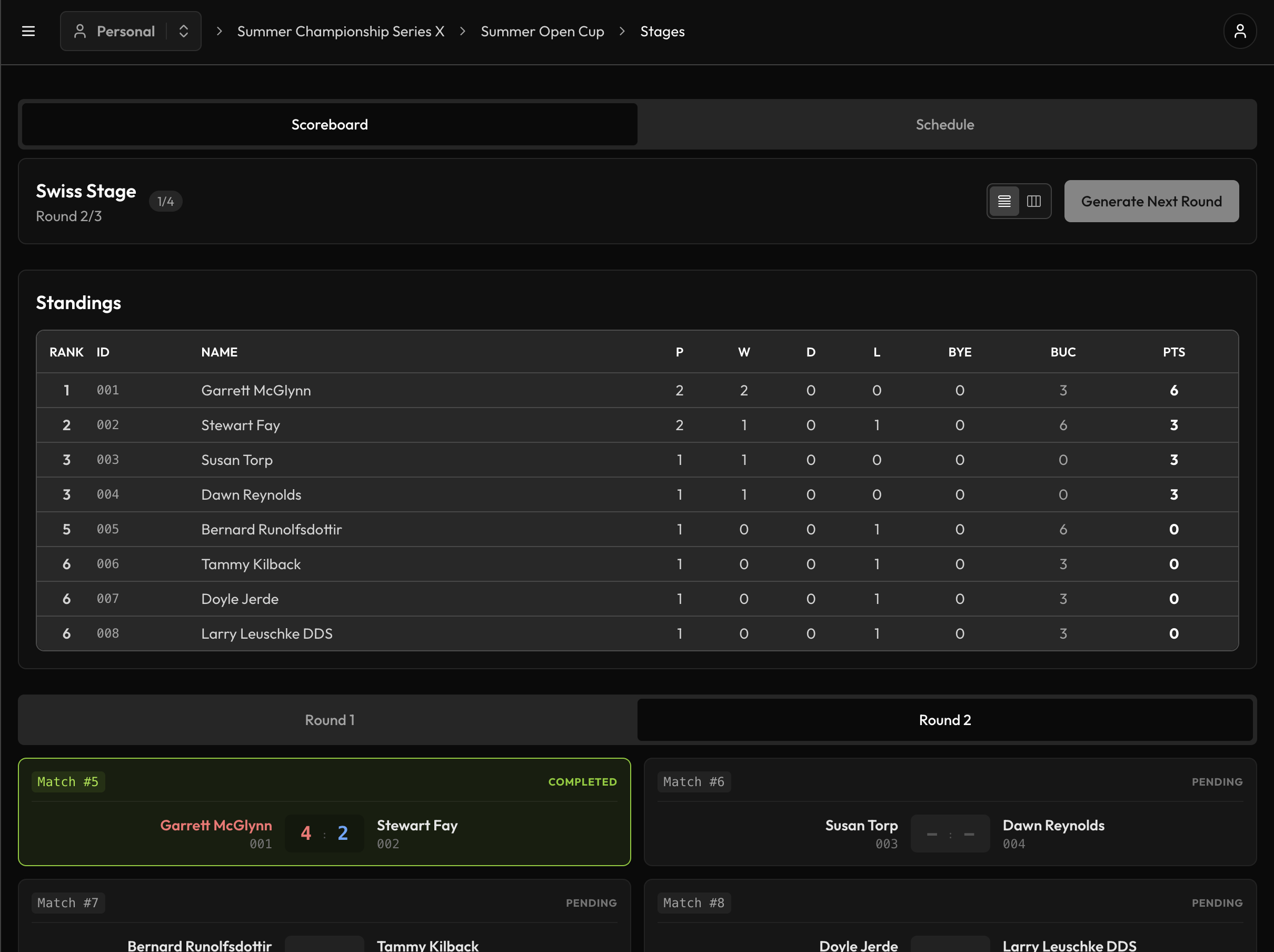
Why can’t I see the round 2 pairings yet?
Because they do not exist yet. Swiss pairs teams on matching records, so round 2 can only be drawn once every round 1 match has a result. Enter the scores above and the next round appears immediately.
Can the same two teams be drawn against each other twice?
No. Avoiding rematches is the dominant constraint in the pairing — the generator will pair teams on unequal points before it will repeat a fixture, and only allows a rematch when no rematch-free pairing of the field exists at all.
Who gets the bye when the field is odd?
The lowest-ranked team that has not already had one, so nobody sits out twice while another team plays every round. A Swiss bye is worth a win at 3 points, and counts as a virtual opponent in that team’s Buchholz.
How are teams level on points ranked?
By Buchholz first — the sum of their opponents’ points, so the team with the harder schedule finishes higher. After that it is head-to-head, then total wins, then seed. Announce that order before the first round.
Can a Swiss stage feed into a knockout bracket?
Yes, on Tournamyx Scores. Chain a Swiss stage into a single elimination bracket and the top finishers are seeded into it automatically when the last round is scored — the shape most esports majors use.
Is the Swiss tournament generator free?
The generator on this page is free and unlimited, and saves nothing. Running the same Swiss event live on Tournamyx Scores is free up to 8 participants; larger fields need a paid plan or a one-off single-event unlock.
Kickoff
Your bracket, five minutes from now.
Free for up to 8 players · $9 per event beyond that · Nothing to install