12 team bracket generator with the four byes handled
Twelve is the number that breaks hand-drawn brackets. It needs a 16-slot draw, which means four byes, and where you put them decides whether the draw is fair. The generator below places them correctly before you have finished typing.
12 teams · 11 matches · 4 rounds · 4 byes placed automatically · type scores to advance winners
Round of 16
Quarter-Finals
Semi-Finals
Final
Type scores straight into the bracket and winners advance automatically. Nothing is saved here; save it on Tournamyx Scores to score live and share the link.
Free up to 8 players · $12 unlocks one event up to 64 · No subscription
In brief
What does the 12 team bracket generator do?
The Tournamyx 12 team bracket generator draws a knockout for twelve teams, placing the four byes needed to reach a clean 16-team ladder. The rest of the bracket is drawn through to the final.
A 12-team single-elimination bracket runs 11 matches across 4 rounds, with 4 byes, which reduces the field to 8 in round two.
Every generator on Tournamyx is free and needs no account. Running the same event live, with scores, standings and a public link, happens at scores.tournamyx.com, free for up to 8 players.
12 team bracket at a glance
- Makes
- A twelve-team knockout with all four byes placed
- Best for
- A field of twelve where a straight knockout has to fit inside a single day
- Price
- Free, with no usage limit, because the generator on this page is not metered
- Account needed
- Nothing to sign up for and nothing to install
- Data stored
- Nothing. The generator runs in your browser, and closing the tab discards the draw
- Largest field
- 12 teams as this page is set up, and up to 64 if you paste a longer list
- Where it stops
- Four teams enter a round later than the other eight. Where that gap is unacceptable, three groups of four into a knockout evens it out
- Live version
- Tournamyx Scores runs the same event live, free for up to 8 players, with a public link spectators open without an account
How it works
Build a 12 team bracket in three steps.
- 1~1 min
Enter your twelve teams
Paste the list in seed order if you have rankings. Seeding matters more at twelve than at eight, because it decides who gets the four byes.
- 2~5 sec
Byes place themselves
Twelve teams sit in a 16-slot bracket, so four byes are needed. They land on seeds 1 to 4, which is both the convention and the fairest reward for ranking.
- 3done
Score it live
Eight teams play in round one, four sit out, and the bracket resolves as you enter scores. Run it on Tournamyx Scores to keep it live for everyone else.
Field guide
Where the four byes go, and why it matters
A single elimination bracket has to be a power of two, so twelve teams play in a sixteen-slot draw and four slots sit empty. Those empty slots are byes, and they are worth something real: a bye is a free win into round two. Handing them out badly is the fastest way to lose the room.
The convention is that byes go to the top seeds, 1, 2, 3 and 4, which means the four highest-ranked teams skip round one and enter at the quarter-final stage. This is not favouritism; it is the reward for finishing high in whatever qualified them, and it also protects the bracket from an early upset that makes the semi-finals look thin. The generator above follows exactly this rule. If you have no rankings at all, shuffle first so the byes land randomly rather than on whoever you happened to type first.
The thing to avoid is placing byes in adjacent slots, which produces a round-two match between two teams that have not played, or bunching them in one half of the draw so one semi-finalist has played two matches and the other has played three. Both happen constantly in hand-drawn brackets. Tournament brackets with byes walks through the failure modes with diagrams.
12 teams, four ways to run it
| Format | Matches | Rounds | Guaranteed games |
|---|---|---|---|
| Single elimination | 11 | 4 | 1 |
| 4 groups of 3 + quarters | 19 | 5 | 2 |
| 3 groups of 4 + quarters | 25 | 6 | 3 |
| Round robin | 66 | 11 | 11 |
Eleven matches, four rounds, two and a half hours
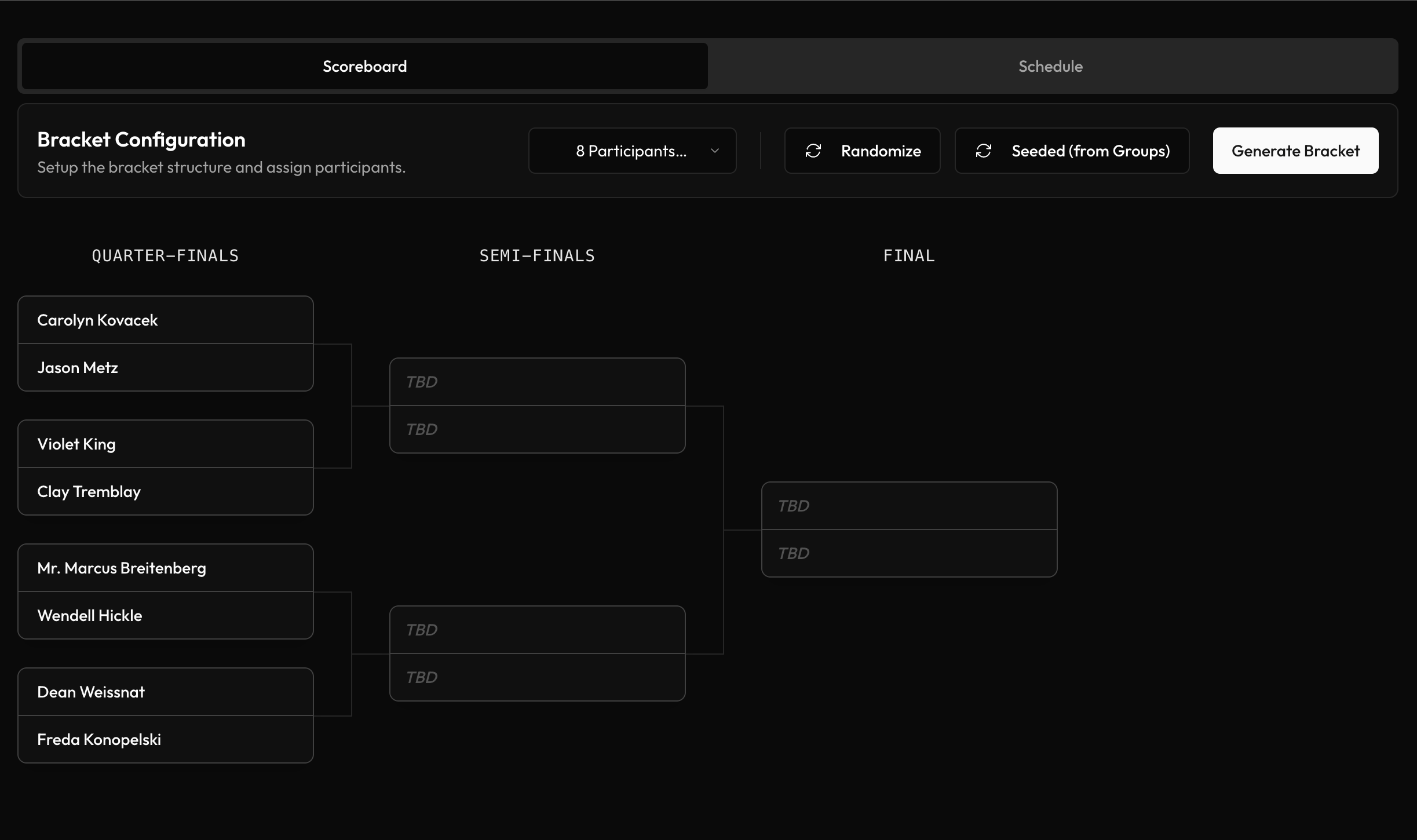
Twelve teams means eleven matches, one per eliminated team, spread over four rounds. Round one is four real matches while four teams sit out; round two is four quarter-finals; then two semi-finals and a final. That asymmetric first round is what makes the twelve-team draw feel odd on paper and perfectly normal in practice.
On two courts at 25 minutes a slot it runs in about two and a half hours: two slots for round one, two for the quarter-finals, one for the semis, one for the final. On four courts it collapses to about two hours, because rounds one and two each fit in a single slot. Rounds run sequentially, so past four courts you stop saving time, because the final still has to wait for the semis.
If two and a half hours is comfortably inside your booking, consider spending the spare time on guaranteed games instead. Four groups of three feeding quarter-finals costs 19 matches and about three and a half hours, and nobody drives home after one game.
When 12 teams should not be a straight knockout
Eleven matches for twelve teams means six teams, half your field, play exactly once. At eight teams that is a defensible trade for a short booking. At twelve it starts to feel thin, because you have enough entrants to fill a group stage properly and the venue is usually booked for longer anyway.
Twelve divides cleanly two ways, which is unusual and useful. Three groups of four gives everyone three guaranteed games for 25 matches total. Four groups of three gives everyone two for just 19, which is the format most one-day twelve-team cups should be running, and the group stage + knockout generator will build it. A full round robin is 66 matches and eleven rounds, which is a league season, not a Sunday.
For a side-by-side with real timings at this exact field size, see the best tournament format for 12 teams.


How many byes does a 12 team bracket need?
Four. Twelve teams sit in a 16-slot bracket, leaving four empty slots. Convention gives them to seeds 1 through 4, so those teams enter at the quarter-final stage while the other eight play round one.
How many matches are in a 12 team bracket?
Eleven, across four rounds: four first-round matches, four quarter-finals, two semi-finals and a final. Single elimination always plays one match per eliminated team, so twelve teams means eleven matches.
How long does a 12 team knockout take?
About two and a half hours on two courts with 25-minute slots, or roughly two hours on four courts. Rounds run sequentially, so adding courts beyond four saves no further time.
Who should get the byes?
The top four seeds, if you have rankings. If you do not, shuffle the list so byes fall randomly, because an arbitrary bye that looks deliberate causes more complaints than a random one.
Is a group stage better than a knockout for 12 teams?
Usually, yes. Four groups of three feeding quarter-finals costs 19 matches instead of 11 and guarantees every team two games rather than one, for roughly one extra hour on two courts.
Can I run this on Tournamyx for free?
The free tier covers events up to 8 teams, so a 12-team event needs a paid plan or a one-off single-event unlock. The generator on this page is free and unlimited. It just does not save anything.
Kickoff
Your bracket,
five minutes from now.
Free up to 8 players · $12 unlocks one event up to 64 · No subscription